




At Zollinger Bio, we are committed to offering only the highest-quality seeds for your garden or balcony. That’s why we regularly perform standardized germination tests in our laboratory.
The quality of our organic seeds for your garden
What could be more frustrating: you prepare your soil, sow your seeds, water carefully, and already imagine a generous harvest… but nothing grows! Was it the weather? Slugs? Or perhaps the quality of the seeds?
Germination tests
To ensure a successful gardening experience, Zollinger Bio is committed to providing top-quality organic seeds. Our team continuously tests all varieties in our range to guarantee the highest possible germination rate. Every week, we carry out what professionals call germination tests in our laboratory in Les Evouettes, Valais.
How are germination tests carried out?
Each year, 50 to 100 seeds from every variety are placed on moist filter paper in a sterile container. Kept under controlled conditions, they are left to germinate so we can assess seed quality. On average, germination rates range between 95% and 100%. It is important to note that what is considered a “normal” germination rate varies depending on the species. For example, fennel typically has a rate of around 85%, while lettuce seeds usually perform better.
If seeds do not meet the required germination rate, the batch is sorted again and retested. Only seeds that meet our strict quality standards are made available for sale. This ensures that our customers receive reliable, healthy, and high-performing organic seeds. This process is entirely carried out by hand and requires time, care, and precision.
Test your seeds at home
If you still have Zollinger Bio seeds from last year and they have been properly stored, you can likely use them again this season. Simply perform a germination test to be sure.
How to perform a germination test:
- Place a piece of filter paper (such as coffee filter paper) in a clean, airtight container.
- Lightly moisten it—it should be damp but not soaked.
- Place a few seeds on the paper using tweezers or a toothpick.
- Close the container and check regularly to ensure the paper remains moist (use a spray if needed).
- Keep the container at a temperature of at least 20°C, in a bright place with indirect light. Depending on the species, germination occurs within 2 to 14 days.
Discover in this video how to carry out a simple germination test at home.
How to store seeds properly
In Israel, scientists successfully germinated a date seed that was over 2,000 years old! While your seeds may not last that long, proper seed storage and preservation can significantly extend their lifespan.
4 rules for proper seed storage
Store your seeds:
- in a dry place
- away from light (in a packet or container)
- protected from rodents
- in a cool environment (10–15°C / 50–59°F)
By following these storage guidelines, most seeds can be kept for 2 to 4 years. However, seeds such as onions, leeks, and carrots should ideally be used within 1 to 2 years.
We recommend storing your seeds in an airtight container. To absorb any remaining moisture, simply add a small amount of dry rice.
Key takeaways
Now that you understand everything about germination tests, seed storage, and proper preservation, you have all the tools you need to successfully grow your plants like a professional.
Because a successful garden starts with high-quality, reproducible, and carefully tested organic seeds, explore our selection and grow with confidence.
👉 Discover our range of organic seeds for your garden or balcony
Germination time depends on the species and growing conditions. Most vegetable seeds germinate within 2 to 14 days. Radishes and lettuce sprout quickly (2–5 days), while carrots or parsley may take longer.
Most seeds germinate best between 18°C and 22°C (64–72°F). A stable temperature is key to successful germination.
Possible reasons include unsuitable temperature, incorrect moisture levels, sowing too deep, or old seeds. Seed quality also plays a crucial role.
Yes, if they have been properly stored (dry, cool, and away from light). However, their germination rate may decrease over time, so performing a germination test is recommended.
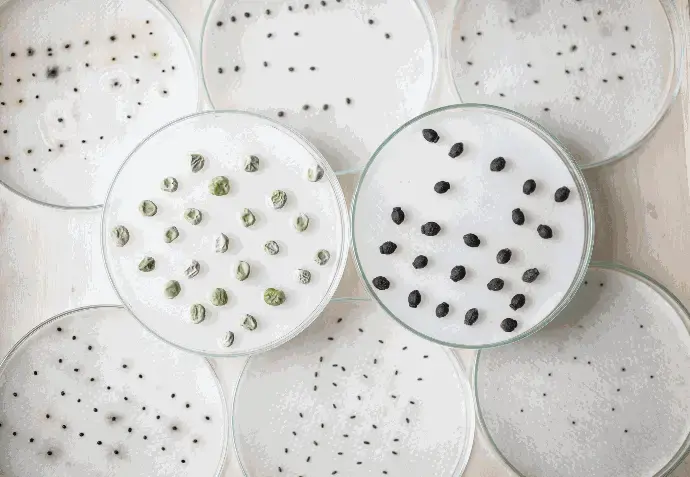
Germination tests of vegetable seeds
Further reading
- University of Geneva: Germer, c’est savoir lâcher prise
- Ready, Set, Seed Germination Test!
Germination tests and seed storage