





Sweet and tangy, raspberries are delicious whether eaten fresh or used in a dessert or jam. Would you like to plant raspberry bushes so you can enjoy the fruit right at hand? In this article, discover everything you need to know to grow raspberries successfully and get a beautiful harvest in your organic garden.
When should you plant raspberry bushes?
Raspberry bushes can be planted between March and November. At Zollinger Bio, we recommend planting in autumn: the soil is still warm, giving the roots time to develop well before winter and encouraging fruiting as early as the start of spring.
What location should I choose for my raspberry bushes?
Before planting your raspberry bushes, choose a sunny spot and allow enough space for the shrub's root development.
When it comes to soil, raspberry bushes are fairly demanding. For a good harvest, choose deep, well-aerated soil that's rich in humus and nutrients. Make sure the soil drains well: standing water increases the risk of rot.
How do you prepare the soil before planting raspberries?
Weed the chosen spot thoroughly and loosen the soil. If your soil is heavy, you can improve it with compost or plant your raspberry bushes on a raised mound of potting soil.
"To improve and loosen your soil ahead of planting, you can sow a green manure mix for compacted soils: the species in the seed mix promote rooting through the different soil layers."

How do you plant raspberry bushes?
- Dip the young plants in water for one to two minutes to moisten the roots.
- Dig holes about twice the size of the root ball. Leave 30 to 50 cm between plants and 2 m between rows.
- Plant your starts 1 to 3 cm deeper than the top of the root ball.
- Fill in with soil and press down lightly.
- Water your freshly planted raspberry bushes generously.
Caring for raspberry bushes
Fertilizing
Fertilize your raspberry bushes sparingly, ideally in early spring. Comfrey liquid manure, for example, strengthens plant tissue and increases the plants' resistance.
Trellising raspberry bushes
Since raspberry canes can grow up to 2.5 metres tall, it's a good idea to trellis them.
- Install two wooden posts on each side of the row.
- Stretch double wires between the posts at heights of 60, 130 and 180 cm.
- Guide the raspberry canes between the wires.
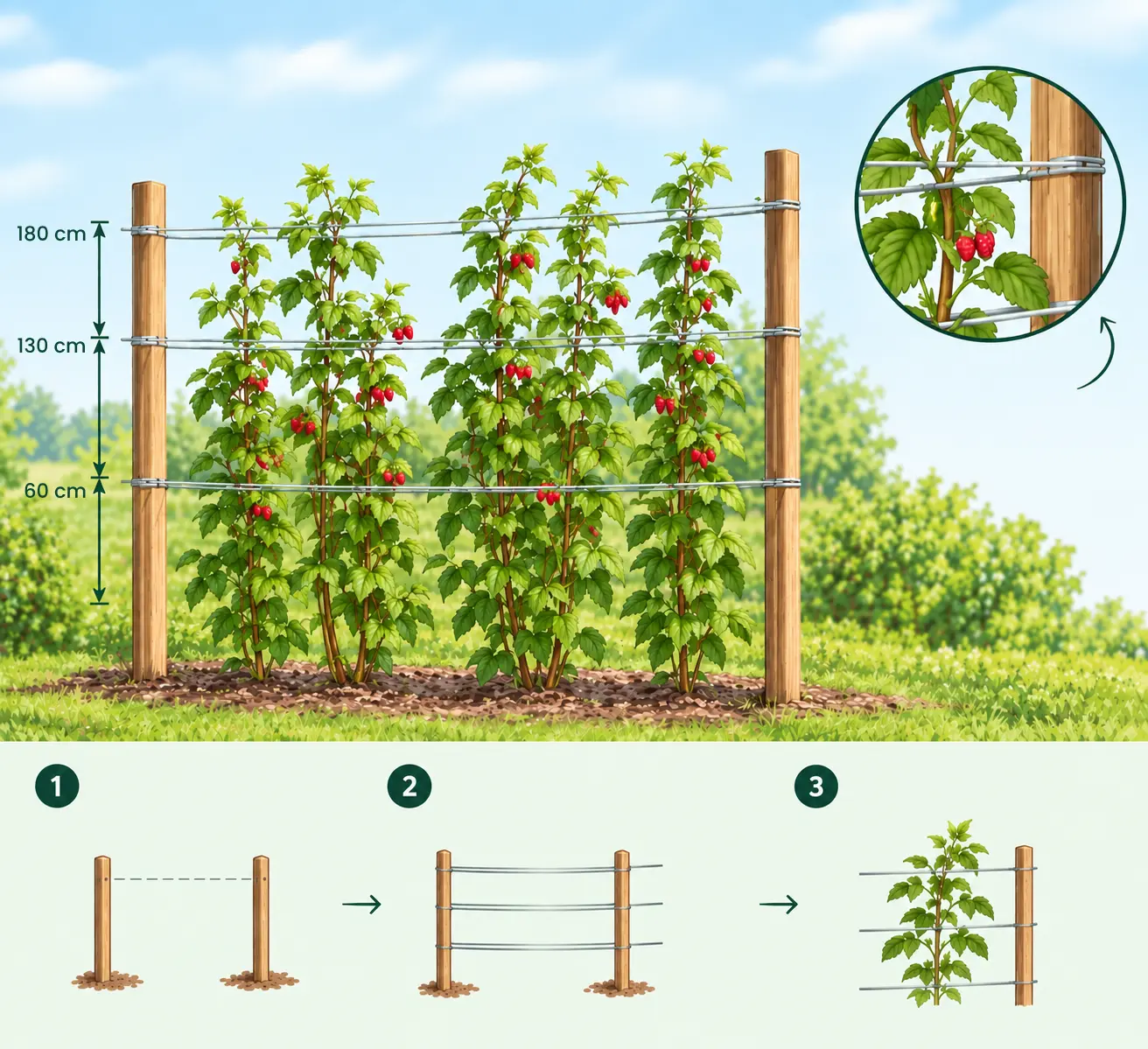
Illustration of raspberry bush trellising.
Watering
Regular, generous watering is needed during flowering and fruit development. However, be careful to avoid standing water, which encourages disease. To ensure a steady water supply, you can install oyas between the raspberry plants.
Mulching
To limit weed growth and retain soil moisture, you can sow grass between the raspberry bushes or apply a layer of mulch. You can also plant low-growing flowers or vegetables at the base of the plants to cover the soil. Raspberry bushes pair well with marigold, forget-me-not or yarrow.
Pruning
The pruning method depends on the type of raspberry bush:
- Summer-bearing raspberries: fruit forms on the previous year's canes. After harvest or during winter, cut back only the canes that bore fruit, right at ground level.
- Autumn-bearing raspberries: fruit forms on the current year's canes. Let them grow in spring, then cut back all the canes in winter to encourage new growth.
Raspberry bush diseases and pests
Botrytis
Raspberries can sometimes be affected by grey mould. This fungal disease, also known as botrytis, develops in humid weather, usually in autumn. A grey fuzz covers the raspberries, which eventually soften and dry out. To reduce the risk, be sure to space and trellis your plants well so air can circulate and standing water is avoided.
Anthracnose
If you notice small red or pink spots on the canes, it may be anthracnose, a disease common in raspberry bushes. If so, remove the affected canes right away.
Spotted wing drosophila
In Switzerland, Agroscope has identified the spotted wing drosophilaalso known as the Suzukii fly, as a pest of raspberry bushes. The fly lays its eggs inside the raspberries. The larvae develop inside the fruit, damaging it. To help prevent it, harvest regularly and remove harvest waste. A fine-mesh net (1.3 mm), installed early, can also help protect the raspberries.
Buy organic raspberry seedling
If you'd like to start growing raspberries, we offer certified organic seedlings on our plant order site. To find the variety that suits you, check out our berry variety comparison.
Frequently asked questions about raspberries
Yes, as long as you choose a deep container and a raspberry variety suited to container growing.
No, raspberry bushes are self-fertile: a single plant is enough to produce fruit.
A young plant usually produces its first fruit in the first or second season after planting.
Unlike most vegetables in the garden, raspberry bushes don't reliably come true from seed. Cultivated varieties result from crosses; growing from seed produces plants that are genetically different from the parent plant, with unpredictable flavour, vigour and productivity.
To learn more
- Schnüriger, M. (2024). Atlas des baies et des fruits (1ʳᵉ éd.). Édition lmz, en collaboration avec la Zürcher Hochschule für Angewandte Wissenschaften (ZHAW) - Institut für Umwelt und Natürliche Ressourcen. ISBN 978-3-03888-400-2. Link to the Atlas
- Agroscope & Fruit-Union Suisse. (2022). Guide des petits fruits. Link to the guide
Growing organic raspberry bushes: the complete guide