




Oyas are perfect for supplying water to plants in the vegetable garden, on the balcony, and even in your living room! Here's how to use these terracotta pots to water your garden or planters.
How do oyas work?
An olla or oya is a terracotta pot used to water plants using an age-old technique. This system, recently rediscovered, has proven highly effective.
The oyas are porous clay vessels used for irrigation. In Asia and Africa, underground water reservoirs are a centuries-old tradition.
The name "ollas" (pronounced "oh-yas") comes from Spanish, meaning "pots." Thanks to a special low-temperature firing technique, the clay they're made from stays porous and permeable to water.
When these vessels are buried in the ground and filled with water, they slowly and continuously release moisture into the soil through their walls. This is what allows plants to be watered directly at root level!
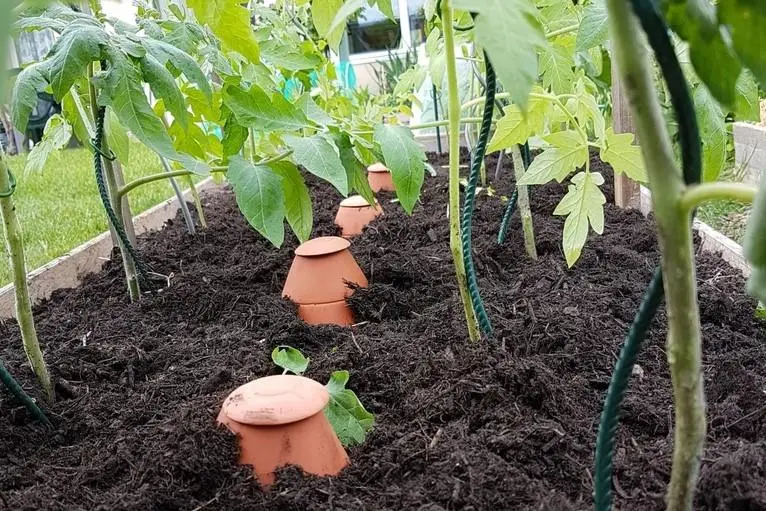
Watering tomato plants with oyas.
What are the benefits of oyas?
Water savings
Oyas offer many advantages. They are a water-efficient watering system. Moisture isn't spread across the surface, but released directly underground, which saves water compared to conventional watering with a can or drip irrigation.
They strengthen your crops
Oyas help maintain moisture, especially at root level. Plants therefore tend to grow deeper roots, making them more resilient in the long run. With traditional overhead watering, only the soil surface gets wet and water evaporates faster.
Conversely, with oya watering, there's no loss through evaporation or runoff. Since the surface stays drier, snails and slugs are less attracted than with conventional watering. Plant foliage also stays dry, which reduces the risk of fungal diseases.
Time savings
Oyas provide a baseline water supply for your plants even when you're away, for example during a short holiday. With this system, watering can be needed up to 3 times less often!
Versatility
Oyas suit large gardens as well as smaller planters. The range of sizes and types allows for irrigating very diverse gardens. Smaller ones are ideal for very dry spots like balconies or pots. Oya garlandsmeanwhile, provide automatic, long-lasting irrigation for large vegetable gardens or even rows of shrubs.
How to install oyas?
Choose a suitable spot, ideally close to the plants that need the most water. Depending on the size of the bed, one or several oyas may be useful. A 6.5-litre container is generally enough to water a 120 x 120 cm bed.
For burying oyas, dig a hole the size of the container in the chosen spot, place the oya inside, and surround it with soil. The top opening should stick out a few centimetres. Then fill the container with water, using a watering can or a garden hose. Refer to the manufacturer's instructions for the exact burial depth and recommended refill frequency.
The oya's opening should then be covered to prevent dirt or small animals from getting inside. To help retain soil moisture, you can add a layer of mulch on top of your oya.
Caring for your oyas
Oyas require no special maintenance, aside from three precautions:
- Water: avoid overly dirty water, which could eventually clog the oya's pores. Rainwater is ideal.
- Frost: don't fill your oya during hard frost, as it could crack. At higher altitudes, the Zollinger Bio team recommends digging them up in early autumn and storing them somewhere sheltered to make them last longer.
- Planting: keep its location in mind when gardening — a misplaced spade strike could be fatal to it.
Discover our range of oyas made in Europe
How to water your garden or balcony with oyas?